Where a garden starts
Updated: 19 September 2026
The house is finished or being fitted out. Around it, imported soil, traces of the build, sometimes a lawn and two or three mature trees. The neighbours can see your terrace and you can see their windows. The plot needs sorting out, and it is not clear where to start, what it costs or when to call us in.
We answer the last one first.
Call us three to six months before any groundwork, ideally while the house is still being fitted out. That leaves time to settle terrace and step levels, bring water and power to where they will be needed, and avoid redoing paving and drainage later. If the build is done and the soil is already in, we can still take it on; some of the decisions simply look different.
People write to us about a plot, a bit of ground, getting it tidied up. Two months later the same people are saying garden. A plot is just the ground around the house. A garden is where you go out in the evening and stay, because it is better than being indoors.
We make naturalistic gardens: perennials and grasses in drifts, with plenty of plants, up to mature trees. The place and the house set the form, and the garden needs little care.
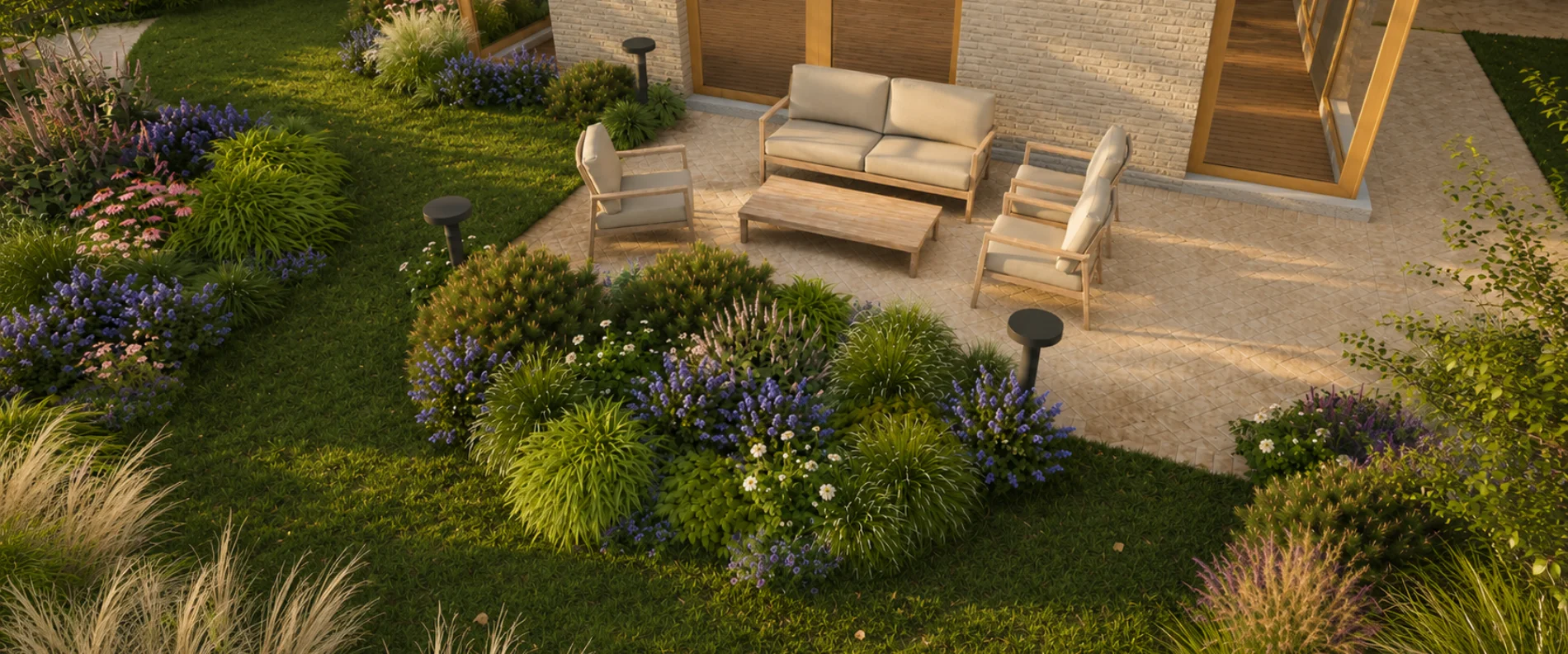
Why this is not overgrowth
A naturalistic garden is easy to mistake for a neglected one, until you know where to look.
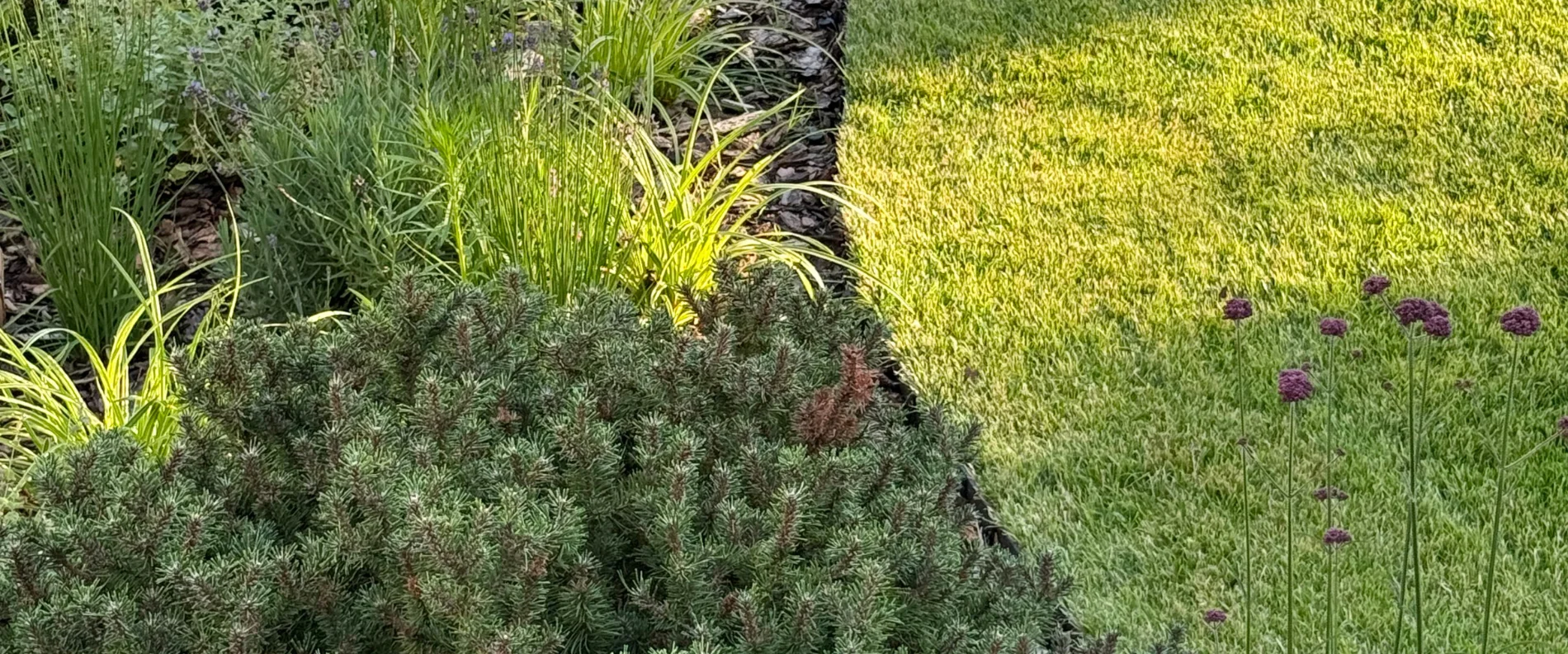
Look at the edge. On a neglected plot the plants spread and there is no boundary. The planting we make has a form. It is clear and deliberate, and it holds everything growing inside it. Inside, there can be freedom: grasses lean over and plants seed themselves where they like. The edge does not move.
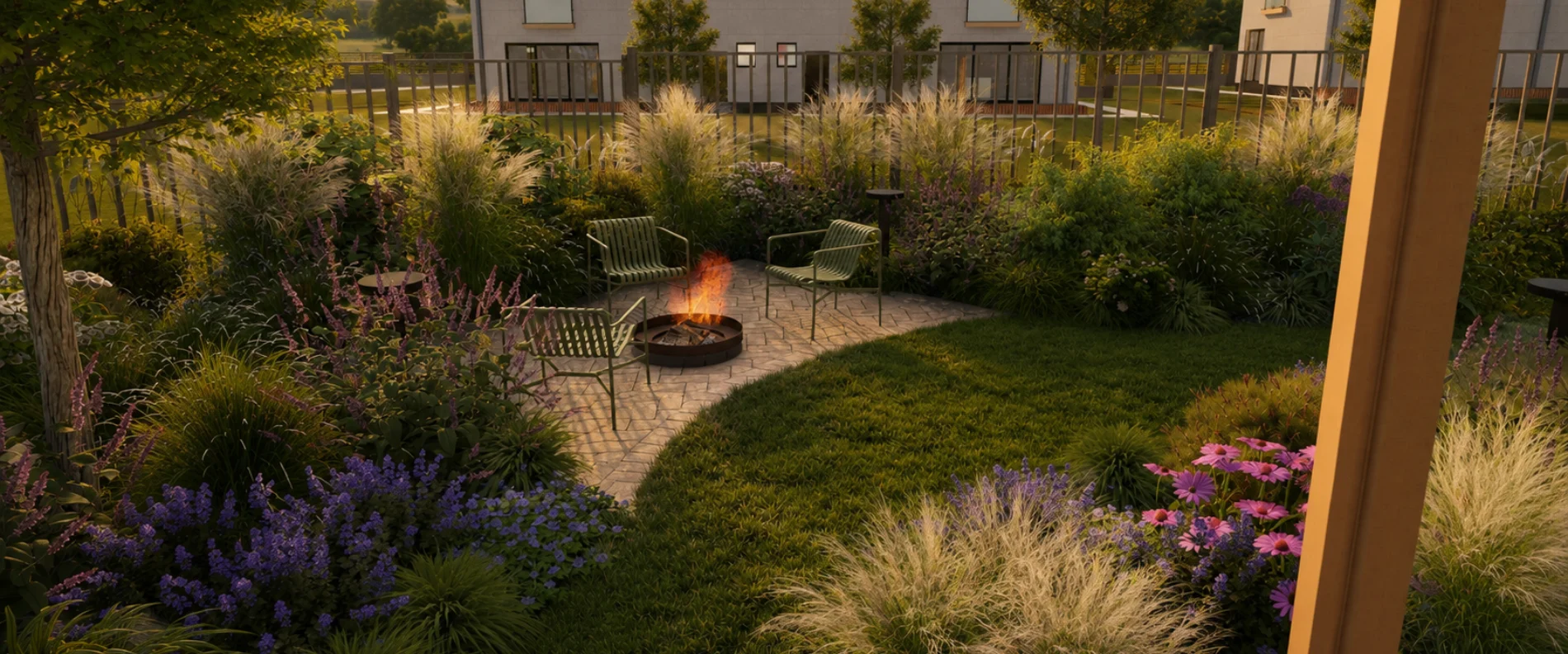
Then the planting itself. These are perennials: they are not remade every year, they come back. The garden changes without starting over.
It changes constantly: May is one thing, July another, in September the grasses rise and hold the volume. A fence in November is what it was in July: you stop noticing it within a week. A garden never gets that chance.
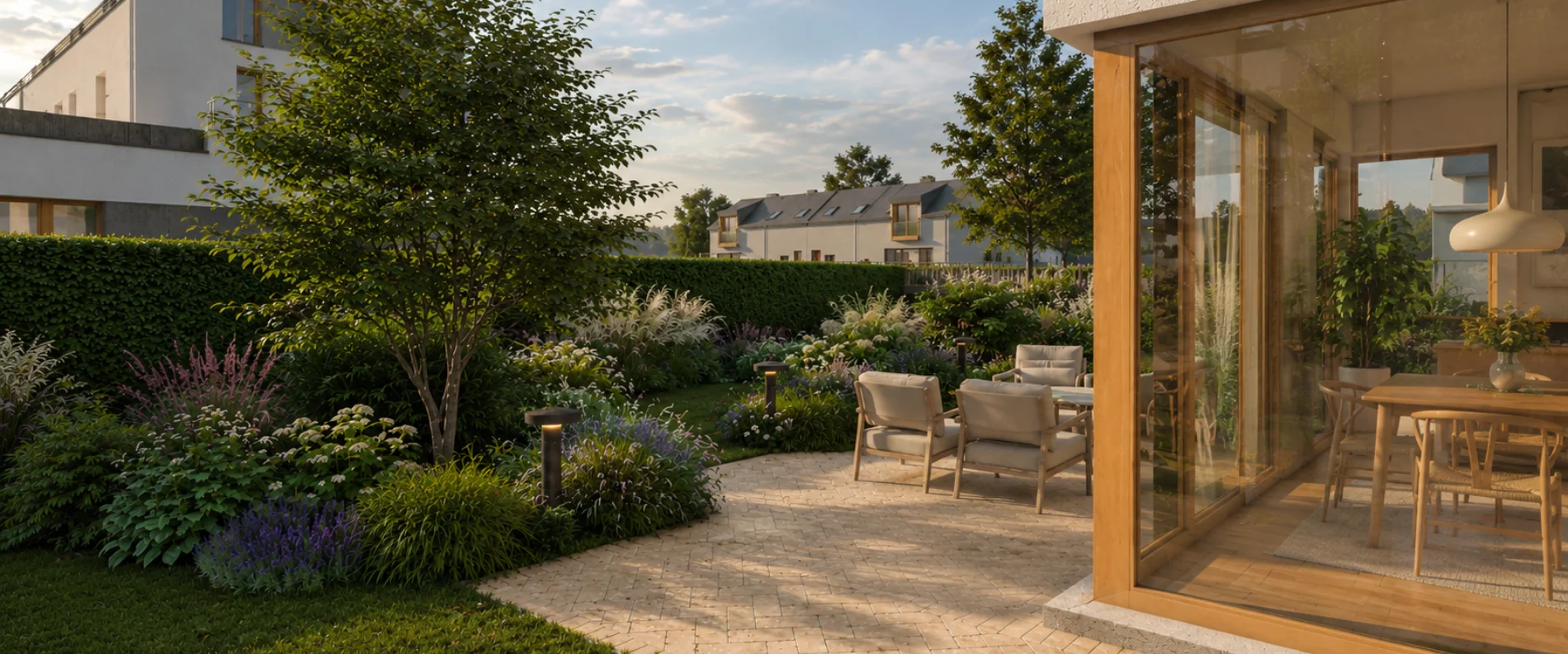
We do not do away with lawn. You need it if you have children or a dog. But we give it a shape a robot can mow, and we do not spread it across the whole plot: lawn eats more maintenance time than anything else, so we usually reduce its area. Irrigation is always automatic. It is not an optional extra.
The rest is perennial planting, which is not clipped. Once or twice a season you go into it and edit. We show exactly how on site and in the maintenance guide, which comes with the design.
The first meeting on site
For the first half hour we simply talk. What time you get home. Where you drink your coffee in the morning. Whether there is a dog and where it runs. Who in the family is up first and what they see from the window. What annoys you about the plot right now.
Those answers decide more than style does: where the fire pit goes, where the path runs, which side of the house will be quiet.
Then we look past the plot.
By now the plot ends at the fence, as far as you are concerned. We look at what is beyond it too. Sometimes it is a line of somebody else’s trees a hundred metres off, or a rough meadow. A view like that can be taken into the garden: leave that side open, keep the air, and the plot starts to read well past its own boundary. The idea is old: it comes from Japanese gardens, where it goes back about a thousand years.
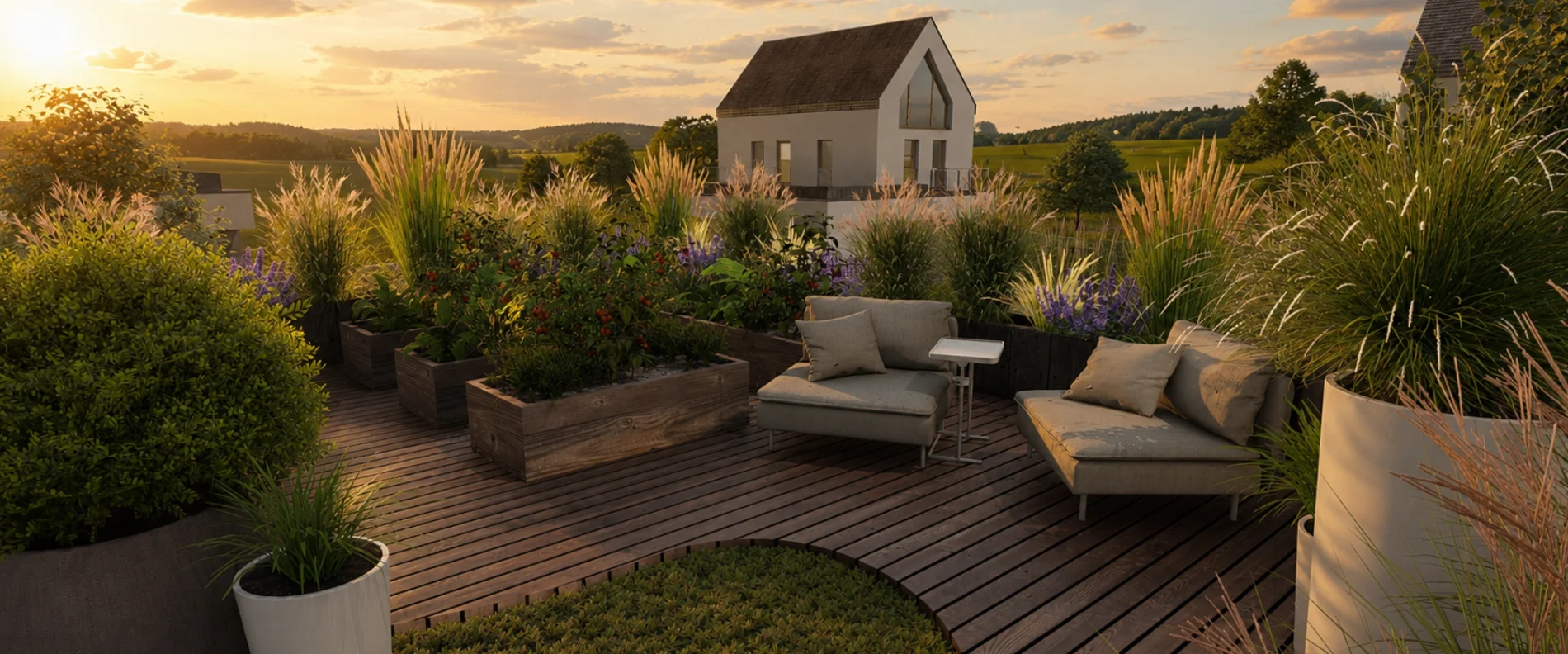
This is also where we ask the awkward question: do you know what is going to be built beyond the fence? A borrowed view is not yours, so we design the garden to stand without it. What to do about that risk is your call. Ours is to show what each option leads to.
On the other side there are usually neighbours and their windows. There are two routes here and we show both. A fence screens the same day. But it is one more wall, and there are enough walls indoors. Shrubs and grasses screen just as well, and they work differently: there is depth to them, a second row shows behind the first, and the plot feels larger. That decision costs time: planting reaches full strength over two to three seasons.
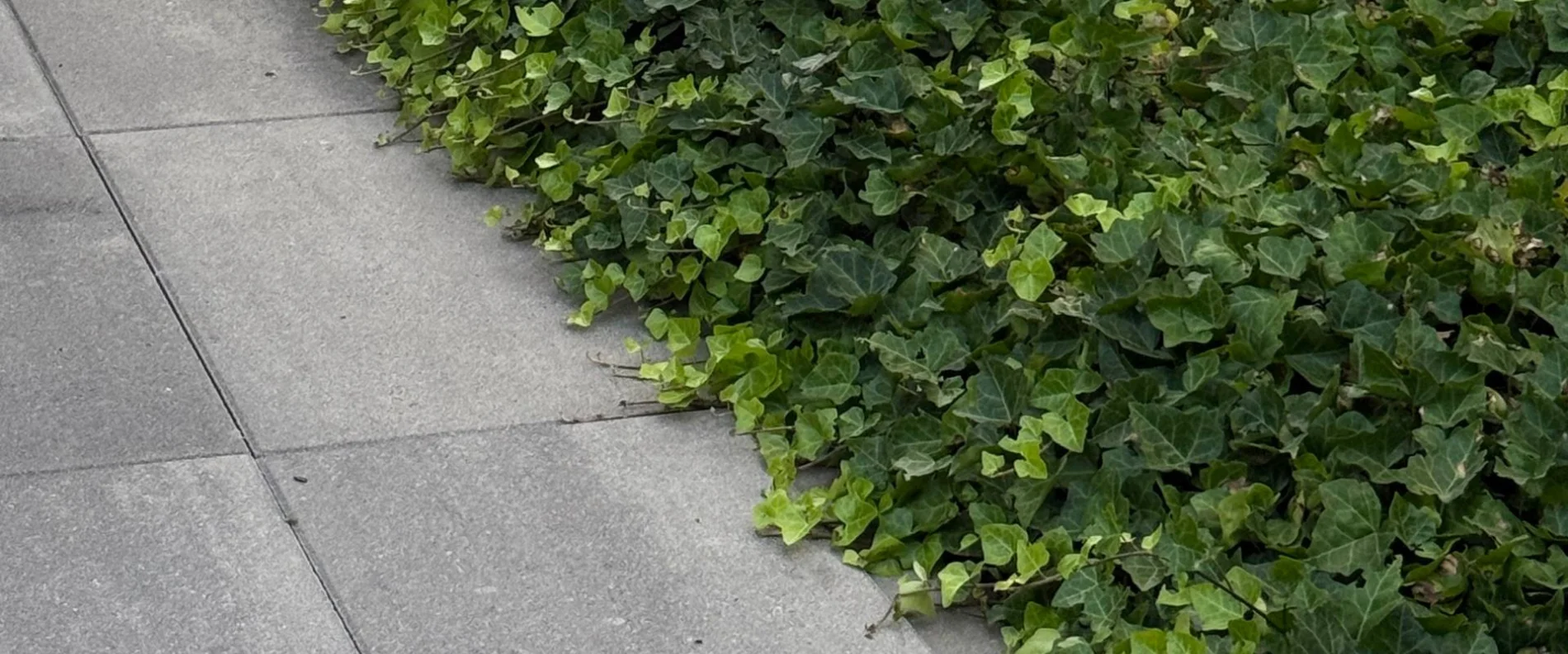
Need the screen immediately? There are two ways and both are honest. Take specimen trees, older plants. They give volume in the first season. It costs more: you are paying for the years a nursery has already spent growing it. A young juneberry is around 300 zł, a large specimen 3,000–4,000 zł; it takes five to eight years to grow one that far.
Or fast-growing shrubs and a hedge: cheaper, but a hedge has to be clipped, every year. We tend to steer away from gardens run on a timetable. If you want one, we will do it well. You will simply know what you are buying.
If you want a fence, we will build a fence. We will say what we think and explain why. After that it is your decision. It often turns out the fence is needed but lower, and after a couple of years the planting hides most of it.
This evening, walk out and look past the fence rather than at the plot. What you see out there we already count as part of your garden.
How the work runs and when you pay
The order is clear before any contract. The design takes about two months and payment comes in two stages.
- A conversation 30 minutes online, free. We give you a range for your plot.
- Contract and 50% deposit For the design work. The site survey follows it.
- Site survey Levels, water, light, wind, the views beyond the fence.
- Concept design Layout, sketch, 3D. We go through it and agree it with you.
- Detailed design Planting, paving, lighting, specification. The remaining 50% before handover.
- Cost estimate for the garden Priced from the finished design, not over the phone or by eye.
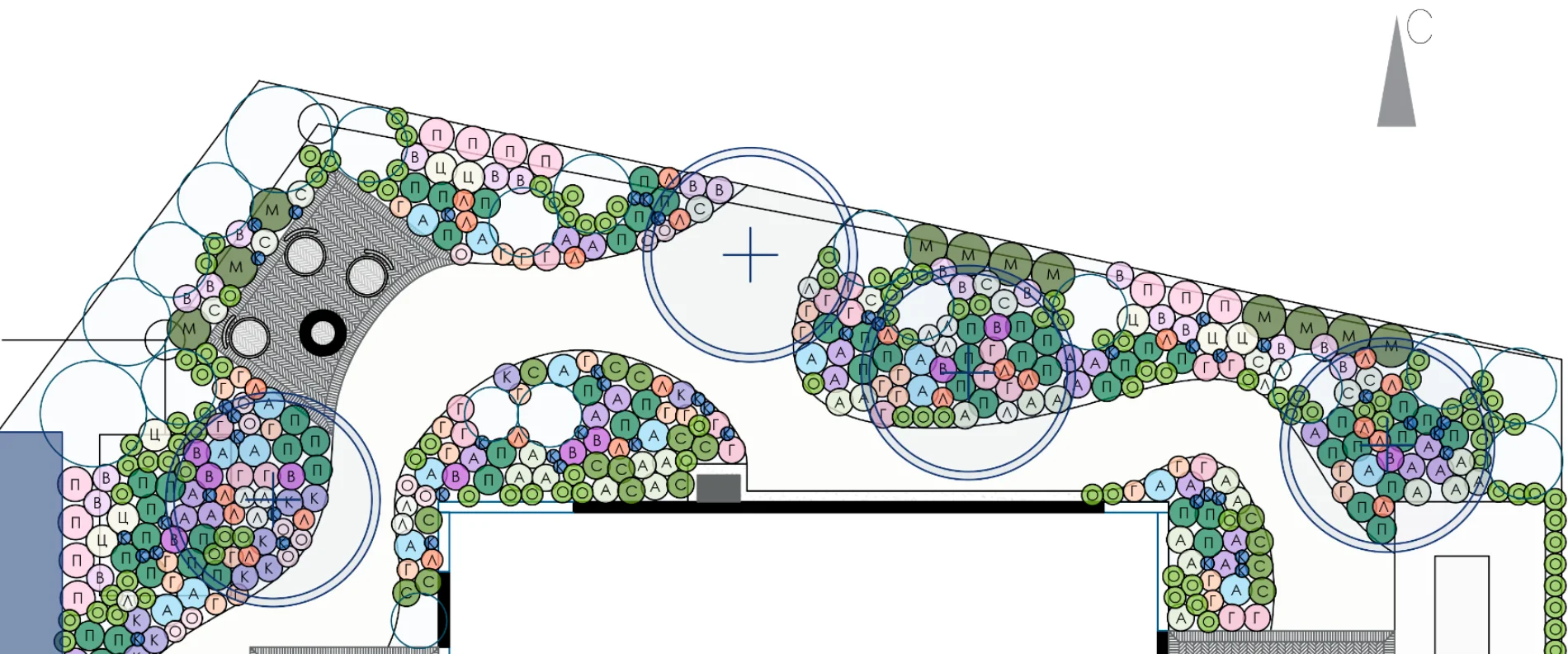
The estimate for the garden itself cannot be given blind: it is priced from drawings, once the crew has seen the plot.
The work runs in order. First what cannot be touched afterwards: levels, drainage, services, paving. Planting and detail go on top. You can build the garden in one season or spread it over several, depending on budget. The order does not change: we tell you what to do and when.
One major change after the concept is approved is on us. Further ones are costed separately, so we are not redrawing the design in circles. Small corrections go in as we work.
Exact figures and example plots are gathered on the price page. And the design carries a specification: for every lighting and material item, the brand, model, quantity and price. All of it visible before the first spade goes in.
One project from the inside
My name is Alexey and I run the projects at Fernaxis. The approach is easier to explain through one garden. Here is a plot outside Kraków.
The client knew what he wanted from the start. He came for planting in the manner of the school of Piet Oudolf: perennials and ornamental grasses set in drifts, as in nature but to a strict scheme. He named the materials himself, travertine and clinker, and wanted a lot of plants. That is rare. Usually a client cannot put a name to the garden they want until later.
Half the plot went to planting. I set the travertine terrace by the living room and ran the lines of the layout out from it. There is no ordinary path: a strip of lawn sets the route and that is where you walk.
The house is tall, so I planted five columnar hornbeams to give the garden enough height to answer it. On one side I deliberately left the perimeter open. There are hills out there, and I took that view into the garden.
A floor above there is a terrace with a door from the house. The design puts a green area there: raised beds and a timber deck with succulents set into it.
Irrigation is automatic and the lawn is designed for a robot mower. The garden runs itself, with maintenance once or twice a season.
For the hedge I suggested thuja, which is steadier. The client did not like the look of it, so we used hornbeam. A garden has to please the person living in it. There is nothing to argue about here.
Behind all of these decisions sits one thing. Form. The form of the garden and the layout.
One thing about Kraków I will say plainly. The paving in the design is difficult but buildable. It is heavier and better looking than usual, and several contractors turned it down although they could have done it. There is plenty of simple work on the market and difficult work gets taken on reluctantly. It left a mark, and I will not pretend otherwise. So around Warsaw the difficult paving is laid by our own crews, and to other cities the design goes out only with our design supervision: nobody straightens a line without us.
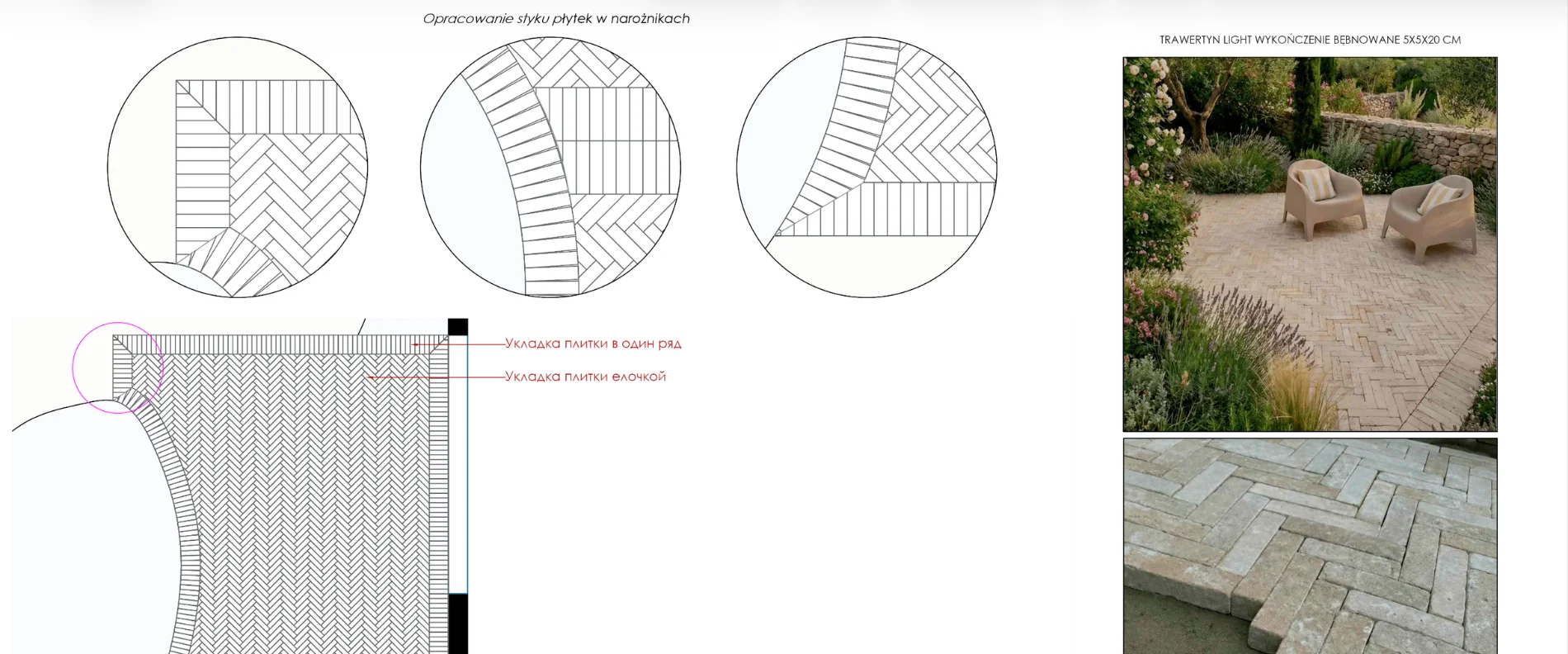
The Kraków project is still being built.
We will show this garden in full, the build and the result, here and on Instagram. That way the whole approach is visible from start to finish. Other gardens, finished and under construction, are in the portfolio.
What clients say

"...It is such a pleasure to work together when everything is clear, specific and done with taste. I look at the result and see how professional and beautiful it all is. Thank you for always being in touch and having an answer to every question..."Julia, Instagram, translated from Russian

"...thank you for the work, for your patience with us and for understanding what exactly we wanted. The design exceeded our expectations..."Marina, Telegram, translated from Russian
Who will design your garden

Alexey Borovik, co-founder and lead designer, is responsible for the design and is your point of contact; he leads the design team and personally oversees every garden.

Maks is responsible for the business model, operations and marketing. We take on only a few gardens a season, and we see each one through ourselves.
We make gardens people want to live in rather than show to guests. We design anywhere in Europe and build in Poland with our own crews; beyond Poland a local crew builds and we stay on the project with design supervision. We ask how you spend your evening and where the dog walks, and we build from that. Price and drawbacks are stated upfront, and if something went wrong we say that too. You have already seen how.
Starting is simple: half an hour of conversation, online, free. You tell us about the plot and we tell you where to start and what it will cost.